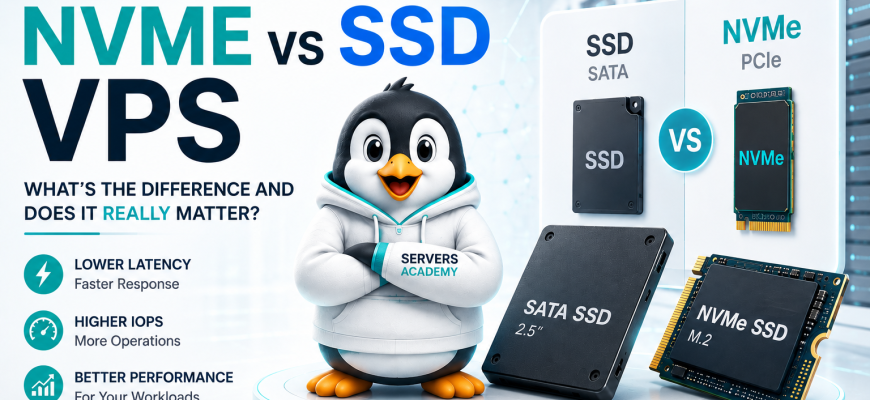
When you compare VPS plans, storage is often reduced to a single marketing label: SSD or NVMe.
NVMe sounds newer, faster, and more expensive — so it must always be the better choice, right?
Not quite.
A good NVMe VPS can be extremely fast. But a poorly configured NVMe platform can still feel slower than a well-built SSD VPS. The storage label matters, but the full storage system matters more.
In this guide, we’ll go step by step through what SSD and NVMe actually mean, how they affect real server workloads, when you’ll notice the difference, and when paying extra for NVMe is mostly unnecessary.
Beginner recommendation: If the price difference is small, choose NVMe. If your workload is light and the SSD VPS is significantly cheaper, a good SATA SSD plan can still be completely fine.
- First: What Is an SSD?
- So What Is NVMe?
- Why Is NVMe Faster?
- More Bandwidth
- Lower Latency
- More Parallel Operations
- What Are IOPS?
- SSD vs NVMe VPS: The Real Difference
- Will You Actually Notice the Difference?
- WordPress: Does NVMe Make It Faster?
- NVMe helps more when:
- What About MySQL and PostgreSQL?
- Why databases love fast storage
- Does Docker Benefit From NVMe?
- When Is SATA SSD Completely Fine?
- ✅ SATA SSD is usually enough for
- 🚀 NVMe is more valuable for
- Why “NVMe VPS” Does Not Always Mean Fast
- Shared Storage
- I/O Limits
- Host Load
- Storage Design
- How to Check Storage Performance on Linux
- Check what storage Linux sees
- Check basic disk statistics
- HDD vs SATA SSD vs NVMe
- HDD
- SATA SSD
- NVMe
- Should You Pay Extra for NVMe?
- Storage Is Only One Part of VPS Performance
- Our Simple Recommendation
- Final Thoughts
- Build Your VPS Step by Step
First: What Is an SSD?
SSD stands for Solid State Drive.
Unlike an old mechanical hard drive, an SSD has no spinning disks and no moving read/write head. It stores data electronically using flash memory.
That makes SSD storage dramatically faster for the kind of small, random reads and writes that servers perform constantly.
The important thing to understand is that NVMe is also SSD storage.
So What Is NVMe?
NVMe stands for Non-Volatile Memory Express.
It is a protocol designed specifically for fast flash storage.
Traditional SATA SSDs use an interface originally designed around older storage technology. NVMe was designed for modern solid-state storage and can handle far more parallel operations.
Why Is NVMe Faster?
There are three big reasons.
More Bandwidth
NVMe can move much more data than SATA, especially during large sequential reads and writes.
Lower Latency
NVMe reduces the delay between a storage request and the system receiving the data.
More Parallel Operations
NVMe can process many more I/O requests simultaneously, which is useful for databases and busy applications.
What Are IOPS?
You will often see storage performance described using IOPS.
IOPS means:
This matters because servers rarely read one giant file from start to finish.
They often perform thousands of tiny operations:
- database reads;
- database writes;
- PHP sessions;
- logs;
- Docker layers;
- cache files;
- package updates;
- mail queues;
- temporary files.
IOPS tells you how many individual operations storage can handle.
For many server workloads, IOPS and latency matter more than the maximum MB/s number.
SSD vs NVMe VPS: The Real Difference
| Feature | SATA SSD VPS | NVMe VPS |
|---|---|---|
| General speed | Fast | Very fast |
| Latency | Low | Lower |
| Random I/O | Good | Excellent |
| Large file transfers | Good | Much faster |
| Databases | Good | Better under load |
| Typical cost | Lower | Slightly higher |
| Best for | General hosting | Performance-sensitive workloads |
Will You Actually Notice the Difference?
This is the question that matters most.
| Your Workload | SSD → NVMe Difference | What You May Notice |
|---|---|---|
| 🎓 Learning Linux | Small | Almost no meaningful difference |
| 🌐 Small cached website | Small | Slightly quicker disk operations |
| 📝 WordPress | Noticeable | Faster updates, database work, cache operations |
| 🛒 WooCommerce | Important | Better database responsiveness under load |
| 🐳 Docker host | Noticeable | Faster container and image I/O |
| 🗄️ Busy database | Big | Lower latency and much better random I/O |
| 💾 Backup server | Depends | Large transfers can be much faster |
WordPress: Does NVMe Make It Faster?
Yes — but the answer needs context.
A WordPress page request may involve:
If the page is fully cached, storage may not be the main bottleneck at all.
But when WordPress needs dynamic PHP execution and database queries, storage performance becomes more relevant.
NVMe helps more when:
- your database is busy;
- you use WooCommerce;
- there are many uncached requests;
- you host several WordPress sites;
- plugins generate lots of database activity;
- you import or export large amounts of data.
What About MySQL and PostgreSQL?
Databases are one of the best reasons to care about storage performance.
A busy database performs constant reads, writes, index lookups, temporary operations and log updates.
Why databases love fast storage
- lower query latency;
- faster writes;
- faster index operations;
- faster temporary tables;
- better performance during concurrent load.
RAM still plays a huge role because good database engines cache frequently used data in memory.
But once the database has to touch storage, NVMe can make a very noticeable difference.
Does Docker Benefit From NVMe?
Usually, yes.
Docker environments can generate lots of small file operations:
- container layers;
- logs;
- volumes;
- database containers;
- package installation;
- temporary files.
Especially when you run many containers or workloads that use persistent volumes.
When Is SATA SSD Completely Fine?
There are plenty of cases where NVMe is not necessary.
✅ SATA SSD is usually enough for
- learning Linux;
- personal websites;
- small WordPress sites;
- VPN servers;
- small APIs;
- lightweight monitoring;
- development servers.
🚀 NVMe is more valuable for
- WooCommerce;
- busy databases;
- many Docker containers;
- high-traffic applications;
- large backups;
- heavy logging;
- frequent data processing.
Why “NVMe VPS” Does Not Always Mean Fast
This is one of the most important lessons in the whole article.
A provider can advertise “NVMe” while the real performance still depends on many other things.
Shared Storage
Many VPS instances may be hitting the same physical storage pool.
I/O Limits
The provider may cap IOPS or throughput per VPS.
Host Load
Heavy activity from neighboring VMs can affect shared infrastructure.
Storage Design
RAID, network storage, caching, controllers and replication all matter.
If storage speed is important, look for actual IOPS, throughput and latency information — or benchmark the VPS yourself.
How to Check Storage Performance on Linux
Before testing anything, remember: benchmarks can generate significant disk load. Do not run aggressive benchmarks on production systems without understanding the impact.
Check what storage Linux sees
lsblkFor more detail:
lsblk -o NAME,SIZE,TYPE,FSTYPE,MOUNTPOINTSCheck basic disk statistics
If iostat is installed:
iostat -xz 1This can help you inspect:
- disk utilization;
- read/write activity;
- queue depth;
- latency.
HDD vs SATA SSD vs NVMe
HDD
Capacity FirstBest when large storage volume matters more than latency.
SATA SSD
Great General PurposeFast, reliable and perfectly adequate for many hosting workloads.
NVMe
Performance FirstBest for databases, containers and I/O-heavy applications.
Should You Pay Extra for NVMe?
Here is the practical decision.
Choose NVMe. The extra performance and lower latency give you more headroom.
For a lightweight workload, a good SATA SSD plan may be the smarter purchase.
NVMe is usually worth prioritizing.
Storage Is Only One Part of VPS Performance
A fast disk cannot compensate for everything else.
A good VPS needs balance.
A server with extremely fast NVMe but too little RAM may still perform poorly. A server with lots of RAM and a weak CPU can also become slow.
If you are still sizing your first VPS, continue with:
- How Much RAM Does Your VPS Really Need? →
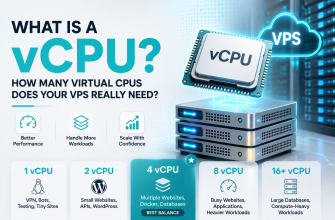
- What Is a vCPU? How Many Virtual CPUs Does Your VPS Really Need? →
- What Is a VPS? A Complete Beginner’s Guide →
Our Simple Recommendation
Final Thoughts
NVMe is genuinely faster than SATA SSD.
But that does not mean every small website needs ultra-fast storage.
For light workloads, CPU, RAM, caching and application configuration may matter far more than the difference between SSD and NVMe.
For databases, WooCommerce, Docker, high-traffic applications and other I/O-heavy workloads, NVMe becomes much more valuable.
Don’t buy a VPS because one word in the specification looks impressive. Choose a balanced server, understand your workload, and use real performance data when you need to scale.