
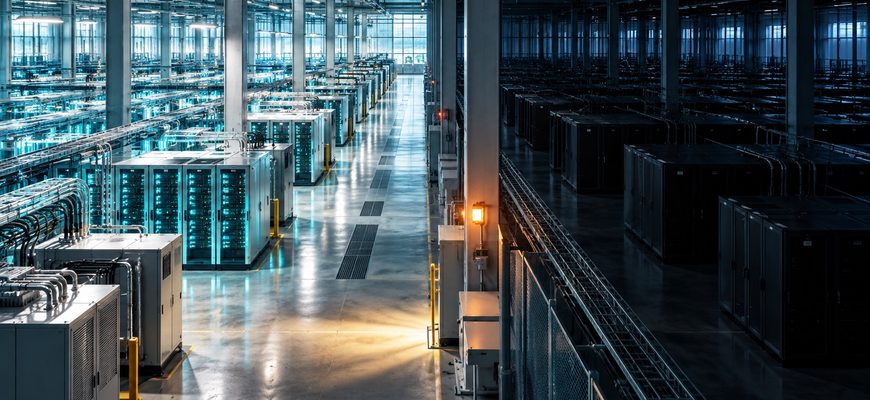
A data center power outage in London disrupted Google Cloud services on October 20, 2026. Banking apps stopped responding. Some services thousands of miles from the affected equipment also experienced problems.
The surprising part was not simply that a building lost electricity. The facility had backup batteries and emergency generators.
Yet a failure in the system responsible for starting and transferring power to those generators helped turn one electrical problem into a regional cloud disruption.
Why could one failed availability zone affect applications running elsewhere? And would your own VPS survive the same kind of outage?
A simplified view of what happens when primary electricity fails and backup generation cannot take over before batteries are exhausted.
Conceptual illustration based on the reported power-failure sequence, not an engineering drawing of Google’s facility.
A data center power outage can interrupt much more than the servers inside one building. Applications may depend on databases, storage, networking and regional control systems. When one availability zone disappears, surviving zones can receive more traffic than they can process. Redundancy helps only when the entire application, its dependencies and its recovery capacity are designed for failure.
- 📰 What Happened During the Google Cloud Outage?
- 🔋 How a Data Center Power Outage Overwhelmed Its Backups
- 🏢 The Cloud Is Not One Giant Computer
- 🌐 Why Did One Failed Zone Affect Other Zones?
- 🧪 Interactive: What Happens When a Cloud Zone Fails?
- 🖥️ Would Your VPS Survive a Data Center Power Outage?
- 💾 Why Backups and High Availability Are Not the Same
- ✅ Five Questions to Ask Before Choosing a VPS Provider
- ❓ Frequently Asked Questions
- 📚 Sources and Technical References
📰 What Happened During the Google Cloud Outage?
On October 20, 2026, multiple Google Cloud services experienced elevated errors, network failures and processing delays in the London region, known as europe-west2.
News organizations reported disruptions affecting services including Revolut, Lloyds and HSBC. Customers experienced problems with banking apps and other online functions.
Google subsequently published a preliminary technical report. Its findings explain why the outage became more complicated than a straightforward loss of electrical power.
The important distinction is between the location of the original physical failure and the much wider footprint of the resulting software and network problems.
According to Google, the loss of power occurred at infrastructure supporting one availability zone. But increased load and dependencies between zones disrupted other services that had not directly lost electricity.
🔋 How a Data Center Power Outage Overwhelmed Its Backups
Data centers do not normally depend on a single electrical connection without protection.
A typical facility uses multiple layers of power infrastructure. These may include grid feeds, uninterruptible power supplies and emergency generators.
A UPS supplies electricity from batteries during the transition to a longer-lasting backup power source. Its batteries cannot support a full data center indefinitely.
In the October incident, Google’s preliminary report identified a failure in the programmable logic controller system responsible for initiating the generator startup and transfer sequence.
The facility experiences an electrical disruption. Backup batteries support its load while emergency generators are expected to take over.
The generator control automation has failed to complete the required startup and transfer. As UPS reserves are depleted, physical infrastructure in the affected zone loses power.
Google engineers receive automated alerts about infrastructure reachability, API errors and timeouts. Recovery operations begin.
Service availability has returned for the vast majority of customer workloads, although some isolated problems remain afterward.
Source accuracy: This sequence comes from Google’s preliminary incident report dated October 22, 2026. The investigation was still ongoing when that report was published.
🏢 The Cloud Is Not One Giant Computer
Cloud computing can feel almost invisible. You create a virtual machine, select a region and begin running software.
But the virtual machine still runs on a physical server somewhere.
That server depends on electricity, networking, cooling and storage. If its physical host becomes unavailable, the virtual machine can become unavailable too.
Cloud providers organize infrastructure into geographic regions and separate availability zones. A region may contain several zones designed to reduce exposure to local failures.
However, choosing a region does not automatically make every application resilient. A VPS or virtual machine running in just one zone may still have a single location of failure.
The difference between physical and virtual servers is one of the foundations of modern hosting. Server location also matters for network performance, as explained in our guide Does VPS Server Location Matter?
🌐 Why Did One Failed Zone Affect Other Zones?
This is the most important technical lesson of the October outage.
Suppose an application runs across three availability zones. One zone suddenly becomes unreachable.
Traffic can be directed toward the remaining zones, but those zones must have enough free capacity to handle it.
At the same time, some software components may still depend on services or metadata in the failed zone.
The result can be a chain reaction involving timeouts, overloaded services, slow database failovers and unsuccessful requests.
Simplified regional architecture showing how surviving zones may receive redirected work.
The moving paths symbolize traffic redirection. They are explanatory, not actual Google Cloud traffic measurements.
Surviving zones suddenly process additional work. If they have insufficient spare capacity, requests can queue or fail.
Applications and control services may still request information from components in the unavailable zone. These calls can time out.
Replicated databases may need to promote a new active instance. That transition can interrupt transactions.
Returning power is only one step. Servers, storage, network paths and services may need verification before normal operation resumes.
🧪 Interactive: What Happens When a Cloud Zone Fails?
The next model lets you explore three possible outcomes of a zonal outage.
It is an educational simulation with deliberately simplified assumptions, not a measurement or reconstruction of Google’s production infrastructure.
Select a scenario to change the simulated state of three availability zones.
Notice that a second zone does not automatically guarantee uninterrupted service.
The application also needs healthy replicas, accessible data, reliable routing and enough spare capacity.
That is why the phrase “multi-zone” describes a design opportunity, not an absolute guarantee of availability.
🖥️ Would Your VPS Survive a Data Center Power Outage?
If you rent a single VPS, it normally relies on a particular physical hosting environment.
Depending on the provider, the virtual machine may be recoverable on another host after a hardware failure. But that is different from having a fully independent copy of your application running in another location.
If an entire facility loses electricity, the provider may need to restore infrastructure before your VPS can restart.
Some providers offer high-availability features or multi-zone deployment options. Others require customers to build redundancy themselves.
| Hosting Design | What It Protects Against | Important Limitation |
|---|---|---|
| Single VPS | Basic server hosting with provider-level infrastructure protections | The application may remain dependent on one location |
| Two VPS Instances, Same Facility | Some individual server or software failures | Both may share facility-wide risks |
| Multi-Zone Deployment | Certain zone-level failures when failover is correctly configured | Dependencies and capacity can still cause disruption |
| Multi-Region Deployment | Broader geographic failure scenarios | More cost, complexity and data-management work |
A cheaper VPS can be perfectly appropriate for a personal project, development environment or noncritical website.
But if a business depends on continuous availability, hosting price alone is a poor basis for infrastructure decisions.
💾 Why Backups and High Availability Are Not the Same
Two ideas are often confused: keeping data safe and keeping an application online.
A backup helps you restore data after damage, corruption or loss. It does not necessarily provide a running server during an outage.
High availability aims to keep a service usable when a component fails. That may require redundant servers, replicated data and traffic failover.
Helps recover information and configurations. Restoration may take time. A backup stored in the same failed location may also be inaccessible.
Uses redundant components to reduce interruption. It needs deliberate design, working health checks, data consistency and tested failover.
Ideally, important services use both. Redundancy reduces downtime, while independent backups provide a recovery path when redundancy alone is insufficient.
✅ Five Questions to Ask Before Choosing a VPS Provider
A data center power outage is a useful reminder to investigate what your hosting plan actually promises.
- Where does the VPS run? Find out whether the provider offers different physical locations and independent zones.
- What happens if the host fails? Ask whether recovery is automatic, manual, or dependent on the affected facility.
- Where are backups stored? Prefer a backup strategy that survives failure of the primary location.
- What does the SLA cover? Understand service credits, exclusions, recovery expectations and your own responsibilities.
- How will you recover? Document a realistic restoration process and test it before an emergency.
Two recovery concepts are especially useful here.
How long your application can tolerate being unavailable after a serious failure.
How much recent data loss your business can tolerate, measured as a time interval.
These objectives help translate vague promises of reliability into practical requirements.
If your website can be offline for an afternoon without serious consequences, a simple backup-and-restore plan may be enough.
If payment processing or critical customer operations cannot stop, you probably need a more resilient design.
❓ Frequently Asked Questions
Can a data center power outage permanently delete VPS data?
Power loss does not automatically mean permanent data loss. But abrupt shutdowns can interrupt writes, and hardware or storage problems can complicate recovery. Independent, tested backups remain essential.
Why did banking apps fail if only one zone lost power?
The reported disruption affected cloud infrastructure used by multiple services. Google’s preliminary report describes redirected traffic, increased load on other zones and cross-zone dependencies. The precise impact on each banking application also depended on that organization’s own architecture.
Does having two VPS servers guarantee high availability?
No. Two servers might still share power, networking, storage or database dependencies. The application needs a complete failover design, not simply two machines.
Can a CDN prevent this kind of outage?
A CDN can continue serving some cached content when the origin server is unavailable. But it cannot automatically restore a failed database or make every dynamic application function work.
Is a cloud provider’s uptime guarantee meaningless?
No. An SLA can describe a measurable service commitment and possible remedies. But it does not eliminate outages or replace application-level resilience planning.
📚 Sources and Technical References
The incident facts in this article are based on Google’s preliminary report and contemporary news reporting. General recommendations about VPS resilience are educational guidance.
- Google Cloud Service Health: London Region Incident — Preliminary Report, October 22, 2026 .
- Associated Press: Coverage of the Google Cloud outage affecting UK banks .
- Google Cloud Architecture: Architecting Disaster Recovery for Cloud Infrastructure Outages .
The most important lesson of the October 2026 outage is not that cloud infrastructure can fail.
Every physical system has potential failure points. The real challenge is preventing a local failure from becoming a much larger interruption.
A server needs electricity. An application needs servers. Those servers may depend on databases, networks, storage and other services.
A resilient application protects the whole chain, not just the machine running its code.