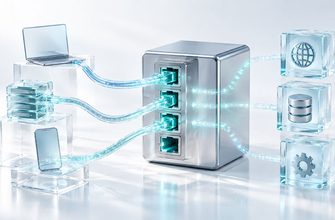
An IP address is one of the basic pieces of information that makes network communication possible. When a server sends a packet to another system, the network needs an address that identifies where that packet came from and where it should go.
For server administrators, understanding IP addresses is more useful than simply memorizing what an address looks like. You need to know why an address belongs to a particular network, what the prefix length means, why a server can have several IP addresses, and why IPv4 and IPv6 look completely different.
An IP address is an address used by the Internet Protocol to identify a source or destination for IP traffic. IPv4 uses 32-bit addresses, normally written as four decimal numbers such as 192.0.2.10. IPv6 uses 128-bit addresses, normally written as hexadecimal groups such as 2001:db8::10.
An IP address is not the same thing as a hostname, a MAC address, or a port number. Those are different pieces of the networking model and serve different purposes.
- What an IP address actually identifies.
- How IPv4 addresses are represented and divided into network and host portions.
- How IPv6 addresses are written and why they are much longer.
- The difference between public, private, loopback, and link-local addressing.
- What CIDR notation such as 192.0.2.0/24 means.
- How to inspect IP addresses on a Linux server.
- 🌐 What Is an IP Address?
- 🧩 What Does an IP Address Identify?
- Server
- Interface
- Address
- 🔢 IPv4: The Familiar Four-Part Address
- 🧱 What Does /24 Mean?
- 🔐 Public vs Private IPv4 Addresses
- 🔄 One Server Can Have Multiple IP Addresses
- 🚀 IPv6: Why Is It So Much Longer?
- IPv4
- IPv6
- 📊 IPv4 vs IPv6
- 📍 Important IPv6 Address Types
- Global Unicast
- Link-Local
- Multicast
- 🧭 What Happens When a Server Sends a Packet?
- 🧪 Mini Lab: Inspect IP Addresses on Linux
- ⚠️ Common Mistakes
- 💡 Practical Notes for Server Administrators
- Which interface?
- Which prefix?
- What scope?
- Which route?
- ✅ Knowledge Check
🌐 What Is an IP Address?
IP stands for Internet Protocol. At a basic level, IP provides addressing and packet-delivery functions between interconnected networks.
An IP address gives the network layer an identifier that can be used as the source or destination of IP packets. This is why an IP address is fundamental to servers: a remote client needs a network-level destination for traffic intended for that server.
Think of the difference between a website name and an IP address this way:
A hostname such as example.com is a human-friendly name. DNS can map names to IP addresses, while IP itself deals with addressing packets. The two concepts are related, but they are not interchangeable.
🧩 What Does an IP Address Identify?
A common beginner shortcut is to say that an IP address identifies a computer. That is useful for a first approximation, but it is not always precise.
IP addressing is associated with network interfaces and IP communication. A single physical or virtual machine can have multiple interfaces and multiple IP addresses. A server may therefore have a public IPv4 address, one or more private addresses, and one or more IPv6 addresses at the same time.
Server
A machine can participate in several networks and therefore use multiple IP addresses.
Interface
An interface connects a system to a network and can have IP addresses assigned to it.
Address
The IP address provides a network-layer source or destination for IP traffic.
When troubleshooting a server, ask “Which interface owns this address?” rather than assuming that a machine has one universal IP address. This distinction becomes important with multiple NICs, virtual interfaces, containers, VPNs, and dual-stack IPv4/IPv6 configurations.
🔢 IPv4: The Familiar Four-Part Address
IPv4 uses a 32-bit address. It is commonly represented as four decimal octets separated by dots.
192.0.2.10Each octet represents 8 bits, so the four parts together make 32 bits.
| Part | Example | Meaning |
|---|---|---|
| Octet 1 | 192 | First 8 bits |
| Octet 2 | 0 | Second 8 bits |
| Octet 3 | 2 | Third 8 bits |
| Octet 4 | 10 | Fourth 8 bits |
The address format is easy to read, but the four numbers do not independently tell you which part is the network and which part identifies a host. That depends on the prefix length or subnet mask.
🧱 What Does /24 Mean?
Modern IP networks commonly use CIDR, or Classless Inter-Domain Routing, notation. You will often see an address written like this:
192.0.2.10/24The /24 is the prefix length. It says that the first 24 bits belong to the network prefix, leaving the remaining 8 bits outside that prefix.
You can think of the notation as:
That visual is simplified, but it captures the core idea: the prefix defines which network an address belongs to, while the remaining bits distinguish addresses within that prefix.
CIDR is important because routers and operating systems use prefixes to understand network boundaries and routing decisions. The same basic idea applies to IPv4 and IPv6.
Do not assume that every IPv4 address with a particular first three octets automatically belongs to the same subnet. The prefix length determines the boundary. For example, 192.0.2.10/24 and 192.0.2.10/28 describe the same address with different network-prefix lengths.
🔐 Public vs Private IPv4 Addresses
Not every IPv4 address is globally routable on the public Internet.
IPv4 has address space reserved for private networks. The three private-use ranges defined by RFC 1918 are:
| Private range | CIDR notation | Typical role |
|---|---|---|
| 10.0.0.0 – 10.255.255.255 | 10.0.0.0/8 | Private networks |
| 172.16.0.0 – 172.31.255.255 | 172.16.0.0/12 | Private networks |
| 192.168.0.0 – 192.168.255.255 | 192.168.0.0/16 | Private networks |
Private addresses are intended for use inside private networks and are not globally unique Internet addresses. A home router, office network, or internal server network can use them without coordinating those addresses globally.
A public IP address, by contrast, is address space intended for use where global Internet routing is appropriate. The important distinction is not simply “one is safe and one is unsafe”; it is about addressing scope and routability.
🔄 One Server Can Have Multiple IP Addresses
This is normal in server environments.
Consider a Linux server with:
eth0    203.0.113.20
eth1    10.10.0.20
eth0    2001:db8:10::20
The example shows three addresses associated with the server’s network configuration:
- 203.0.113.20 represents an IPv4 address from a documentation range used for examples.
- 10.10.0.20 is a private IPv4 address.
- 2001:db8:10::20 is an IPv6 documentation address.
The actual routing and interface configuration determines how traffic uses these addresses. A server does not automatically send every packet through every address it owns.
🚀 IPv6: Why Is It So Much Longer?
IPv6 was designed as the successor to IPv4 and uses 128-bit addresses instead of IPv4’s 32 bits. The larger address size provides a vastly larger address space and supports a different addressing architecture.
A conventional IPv6 address looks like this:
2001:0db8:0000:0000:0000:0000:0000:0020IPv6 represents its 128 bits as eight groups of hexadecimal digits. Leading zeroes can be omitted within a group, and one consecutive run of all-zero groups can be compressed using ::.
The previous example can therefore be written as:
2001:db8::20The compression is only a notation rule. It does not make the address shorter internally; the underlying address remains 128 bits.
IPv4
32-bit addresses, normally written as four decimal octets separated by dots.
IPv6
128-bit addresses, normally written as hexadecimal groups separated by colons.
📊 IPv4 vs IPv6
| Property | IPv4 | IPv6 |
|---|---|---|
| Address size | 32 bits | 128 bits |
| Typical notation | Dotted decimal | Hexadecimal groups |
| Example | 192.0.2.10 | 2001:db8::10 |
| Address separator | . | : |
| Private/local addressing | Private-use ranges exist | Includes link-local and other defined address types |
IPv6 is not simply “IPv4 with bigger numbers.” It changes the address format and includes different addressing mechanisms. For example, IPv6 defines unicast, anycast, and multicast addressing, and IPv6 does not use broadcast addresses in the IPv4 sense.
📍 Important IPv6 Address Types
IPv6 addresses have different roles and scopes. Beginners do not need to memorize every special range, but three concepts are especially useful when administering servers.
Global Unicast
Addresses intended for global routing and ordinary Internet-scale communication.
Link-Local
Addresses used on a single network link. Routers do not forward link-local traffic between links.
Multicast
An address can represent a group of interfaces, allowing traffic to be delivered to multiple members of that group.
IPv6 addressing is defined by several standards, so server administrators should rely on the actual address configuration and prefix rather than trying to infer an address’s role from appearance alone.
🧭 What Happens When a Server Sends a Packet?
An IP address does not contain the entire route to a destination. It is an addressing component used by the IP layer. Routing systems determine where packets should be forwarded next.
A simplified model looks like this:
Suppose a server wants to communicate with a remote destination. The IP layer places source and destination IP addresses into the IP packet. The local system then uses its routing information to determine how the packet should leave the machine.
Routers along the path examine the destination address and make forwarding decisions. The packet can therefore cross multiple networks without every intermediate router needing to know the complete end-to-end application context.
An IP address tells you where traffic is addressed at the IP layer, but it does not tell you which application should receive it. That is where the next networking concept—ports—becomes important. An address can identify the destination host/interface, while a port identifies a transport-layer service endpoint.
🧪 Mini Lab: Inspect IP Addresses on Linux
Goal: identify the IP addresses currently configured on a Linux system and see which interfaces own them.
The standard ip utility can display addresses assigned to network interfaces. The following command only reads configuration; it does not change the system.
ip addressLook for interface sections containing lines beginning with inet and inet6.
A simplified example might look like:
inet 192.168.1.20/24
inet6 2001:db8:1::20/64
From this output, you can identify:
- Address family: inet indicates IPv4 and inet6 indicates IPv6.
- Address: the value before the slash.
- Prefix length: the number after the slash.
- Interface: the network interface section containing the address.
You can also ask the system which route it would use for a particular destination:
ip route get 1.1.1.1This is useful because it moves the investigation from “What addresses does this server have?” to “Which route would the kernel choose for this destination?” The exact output depends on the server’s routing configuration.
⚠️ Common Mistakes
An IP address identifies the network-level source or destination. A port belongs to the transport layer and helps identify a service endpoint on that address. 203.0.113.20:443 therefore combines an IP address with a TCP or UDP port number.
Private-use IPv4 addresses are specifically intended for private networks and are not globally routable Internet addresses. Other special-purpose addresses also have defined scopes or restrictions.
A server can have multiple interfaces and multiple addresses. Modern systems can also run IPv4 and IPv6 simultaneously, so seeing several addresses is normal.
The network boundary is determined by the prefix length, not by a visual rule such as “the first three octets.” CIDR allows network prefixes of different lengths.
IPv6 uses a different 128-bit address format and has its own addressing architecture, including unicast, anycast, multicast, and link-local addressing.
💡 Practical Notes for Server Administrators
When looking at an IP address on a server, avoid asking only “What is this number?” A more useful investigation asks several questions:
Which interface?
Find the network interface or virtual interface associated with the address.
Which prefix?
Read the CIDR prefix to understand the network boundary.
What scope?
Determine whether the address is globally routable, private, link-local, loopback, or otherwise special-purpose.
Which route?
Check the routing table when you need to understand how traffic will leave the server.
This way of thinking is especially useful when diagnosing connectivity problems. If a service is unreachable, the IP address itself is only one part of the investigation. You may also need to examine routing, firewall rules, transport ports, DNS, and the service listening on the destination.
✅ Knowledge Check
- Why can one server legitimately have several IP addresses?
- What does the /24 in an IPv4 address describe?
- Why is 192.168.1.20 not normally used as a globally routable Internet address?
- What is the fundamental difference between IPv4 and IPv6 address size and notation?
- If an IP address identifies the network-level destination, what additional information is normally needed to identify a particular TCP or UDP service?
- Why should you check the routing table instead of assuming that a server will use a particular interface for every destination?
🎓 Check Your Answers
- A server can have multiple network interfaces, virtual interfaces, or addresses assigned to the same interface. IPv4 and IPv6 can also be configured together, so multiple IP addresses on one server are normal.
- The /24 is the CIDR prefix length. It indicates that the first 24 bits form the network prefix, while the remaining bits are outside that prefix and can distinguish addresses within it.
- 192.168.1.20 belongs to the RFC 1918 private-use IPv4 space. These addresses are intended for private networks and do not have globally unique meaning on the public Internet.
- IPv4 uses 32-bit addresses and is normally written as four decimal octets. IPv6 uses 128-bit addresses and is normally written as hexadecimal groups separated by colons, with rules that allow zero compression.
- A transport-layer port is normally needed to distinguish a service endpoint. For example, an address combined with port 443 identifies a particular transport-layer destination associated with a service, subject to the protocol and service configuration.
- The routing table determines which route and interface the system should use for a destination. A server can have multiple interfaces and routes, so the chosen path cannot safely be inferred from the IP address alone.
An IP address is a network-layer address used to identify sources and destinations of IP traffic. IPv4 uses 32 bits and dotted-decimal notation; IPv6 uses 128 bits and hexadecimal notation.
For practical server administration, never look at an IP address in isolation. Read its prefix, understand its scope, identify the interface that owns it, and check the routing configuration when you need to know how traffic will actually move.